
 Mobile connectivity
May 31, 20267 min
Best Japan eSIM 2026: comparison of the 7 best providers
Comparison of the 7 best eSIMs for Japan in 2026: price per GB, network, coverage. voilà leads the way at $0.63/GB on NTT Docomo.

Are you preparing your trip to Japan and wondering if you can stay connected without blowing your budget? Good news: free wifi in Japan exists, and it's almost everywhere. Airports, train stations, konbini, cafes: tens of thousands of access points are waiting for you.
But between crowded networks, endless check-ins, and dead zones, the reality is more complicated. In this article, you'll see where to find free wifi, how to connect step-by-step, if public wifi is actually reliable, and which solution to choose to keep a stable internet connection everywhere.
We'll tell you everything, straight up.

SOUTH KOREA
active
20 Go
remaining
Operator
SKTelecom, LGU+
Expires
In 3d • Jun 12
Top up

THAILAND
active
20 Go
remaining
Operator
AIS
Expires
In 3d • Jun 12
Top up

JAPAN
active
20 Go
remaining
Operator
NTT docomo
Expires
In 3d • Jun 12
Top up
No blocked apps
Tethering enabled
24/7 customer support
No blocked apps
Tethering enabled
24/7 customer support
Travel abroad with confidence: no more roaming fees, connection struggles, or unexpected top-ups. With a travel-friendly eSIM, stay connected everywhere, stress-free and surprise-free.
Yes. Japan has massively deployed free Wi-Fi in public places, especially to welcome the millions of tourists visiting the country every year. We're talking about more than 150,000 free Wi-Fi zones accessible via a single app, in 16 languages.
To be clear: in big cities like Tokyo, Osaka, or Kyoto, accessing the internet via free Wi-Fi is still possible almost everywhere, in most stations, airports, cafes, and shops. Coverage is excellent in urban areas, but much more hit-or-miss in the countryside and depending on the region.
The real issue isn't whether there's Wi-Fi, but whether that public Wi-Fi will be reliable right when you need it. And in that case, the answer is a bit more mixed.
Here are the places where you can connect to the internet for free in Japan, from the first to the last day of your trip.
All major airports offer free Wi-Fi. At Narita Airport, look for the "FreeWiFi-NARITA" network in terminals 1 and 2 (but not terminal 3, which is reserved for low-cost flights). At Haneda, it's "HANEDA-FREE-WIFI", available in all three terminals, with no registration required and available in several languages, including French.
The railway company JR East offers the "JR-EAST_FREE_Wi-Fi" service in major train stations in Tokyo, as well as at Narita and Haneda airports. To use it, just select the network, click on "Register now", enter your email address, and confirm. The connection lasts up to 3 hours, and you can renew it as many times as you want. All the train and subway stations on the Yamanote line are covered, which is super convenient for your daily commute.
Konbini (like Seven-Eleven, via the Seven & i group) offer free Wi-Fi in more than 10,000 stores open 24/7. When it comes to cafes, Starbucks is the largest provider of free Wi-Fi in the country: select "at_STARBUCKS_Wi2", open your browser, type "Connect to Internet", and accept the terms. McDonald's and Tully's Coffee also offer the service in most of their restaurants.
Most modern hotels include free Wi-Fi directly in the rooms, providing a fast and stable connection. Watch out for traditional ryokans and small accommodations in rural areas, where Wi-Fi is sometimes limited to common areas. In Tokyo, the public network "FREE_Wi-Fi_and_TOKYO" covers more than 630 tourist spots: museums, parks, gardens, and cultural centers. You should also check with the local tourist office, which is often a useful source of info.
Instead of manually juggling between Wi-Fi networks, one app centralizes everything and saves you from having to re-register every time you move to a new place.
Regarding operators, SoftBank offers free access to its hotspots (« FREE Wi-Fi PASSPORT ») and NTT East offers up to 14 days of Wi-Fi via its terminals, just by signing up on their website. These services require a little bit of setup, but they're worth it if you're staying for a long time.
Tip: remember to download these apps before you leave, while you still have an internet connection at home. Searching for "free wifi in japan" once you're there, without any signal, is like chasing your own tail.
That's THE question to ask yourself. Honest answer: public Wi-Fi helps in a pinch, but it quickly shows its limits.
The result: for checking a map quickly or sending a message, it's fine. But for a multi-day trip where you depend on GPS, translations, and real-time bookings, it's risky to rely entirely on free Wi-Fi.
If you want a reliable connection everywhere, without depending on a hotspot, you have three paid options to complement free Wi-Fi. Here is the comparison.
| Solution | Estimated cost | Reliability | Who is it for? |
|---|---|---|---|
| Free Wifi | $0 | Variable, depends on the location | Small budget, occasional use |
| Pocket wifi (portable router) | ~$70/week | Correct, but you have to recharge and return the device. | Bulky and expensive, we don't recommend it |
| Physical SIM card | ~$23 to $35 | Good | Solo traveler, unlocked phone |
| eSIM | from $1.40 | Excellent, instant activation | eSIM compatible phone |
On social media, many travelers share the same advice: avoid pocket Wi-Fi in Japan. The device is bulky, you have to recharge it every night and return it at the end of your trip, for a cost that's around $70 per week. In 2026, an eSIM is installed in just a few minutes before you leave: you land already connected, with nothing to carry or return.
So, about pocket wifi, we told you: avoid it. A physical SIM card (like a Japanese Sakura Mobile SIM or a travel SIM) forces you to buy a SIM on-site, wait in line at a shop, and fiddle with your chip, just one more hassle. An eSIM, on the other hand, installs without a physical SIM card: you just download your plan and your internet connection activates all by itself as soon as you land.
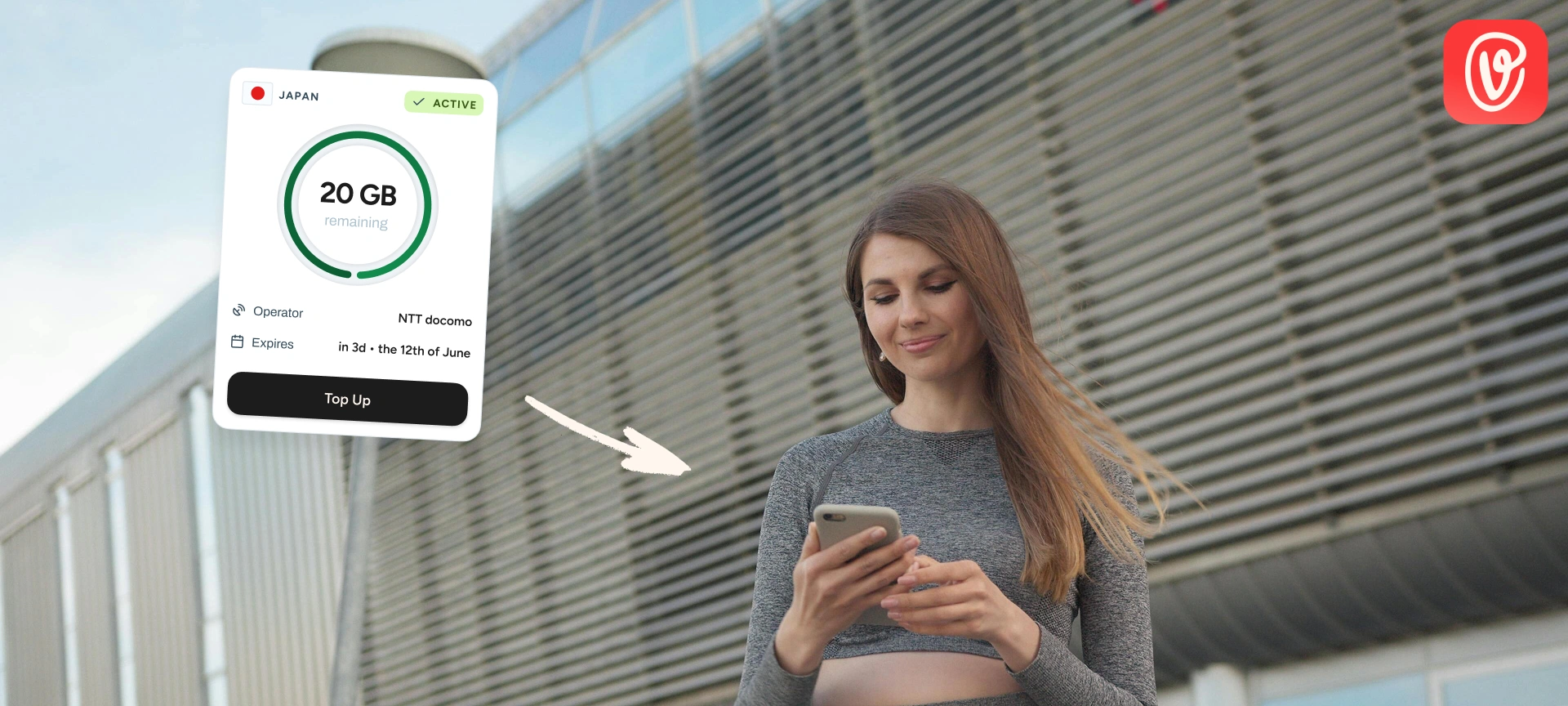
If you want the simplicity of wifi without the hassle, the voilà eSIM for Japan is the most direct solution. No card to insert, no shop to find at the airport: your eSIM connects automatically the moment you land, on the NTT Docomo network.
Prices for Japan (verified on voilacreators.com):
| Plan | Validity | Price |
|---|---|---|
| 1 GB | 7 days | $1.40 |
| 5 GB | 30 days | $5.50 |
| 10 GB | 30 days | $9.60 |
| 20 GB | 30 days | $16.80 |
| 50 GB | 30 days | $34.90 |
Whether you're traveling for one week or three, the price you see is the final price, with no roaming fees or nasty surprises. All your apps work (Google Maps, TikTok, banking apps), hotspotting is included, and support is human, 7 days a week on WhatsApp. The 20 GB plan is our recommended option for a typical two to three-week stay.
Most recent models are, and it's easy to check: iPhone XS and newer, Samsung Galaxy S20 and newer, Google Pixel 3 and newer.
To install it, it couldn't be simpler: follow our method to install an eSIM in just a few clicks, everything is done easily from the app.
Are you hesitating on how much data to get? The voilà GB simulator helps you choose the right plan based on your usage and the length of your stay.
And if you want to compare all the eSIM offers available for the country, take a look at our best eSIM Japan comparison.
Free Wi-Fi in Japan is very real and handy for occasional use: a message, a map, or a photo for your social media. But for a stress-free trip to Japan, where you rely on GPS and translations every single moment, it's better to have an internet connection that's just for you. A voilà eSIM guarantees you that peace of mind to travel connected, starting from just $1.40, without a physical SIM card or hidden fees. It's up to you depending on your itinerary and budget, and above all, enjoy your stay.
SOUTH KOREA
active
20 Go
remaining
Operator
SKTelecom, LGU+
Expires
In 3d • Jun 12
Top up
THAILAND
active
20 Go
remaining
Operator
AIS
Expires
In 3d • Jun 12
Top up
JAPAN
active
20 Go
remaining
Operator
NTT docomo
Expires
In 3d • Jun 12
Top up
No blocked apps
Tethering enabled
24/7 customer support
No blocked apps
Tethering enabled
24/7 customer support
Travel abroad with confidence: no more roaming fees, connection struggles, or unexpected top-ups. With a travel-friendly eSIM, stay connected everywhere, stress-free and surprise-free.
Rony is our in-house travel-connected expert. Always curious and never too far from an airport, he explores the latest destinations while testing the newest eSIM solutions. He signs our articles on travel and mobile technology, with a single mission: to turn his discoveries into clear, reliable, and smart advice to accompany you anywhere in the world.
See all articlesMobile connectivityComparison of the 7 best eSIMs for Japan in 2026: price per GB, network, coverage. voilà leads the way at $0.63/GB on NTT Docomo.
 Mobile connectivity
How to access the internet in Japan? All the solutions to stay connected during your trip (eSIM, free Wi-Fi, Pocket Wi-Fi, etc.)
 eSIM Guides
To set up an eSIM on your phone: Settings > Cellular Data > Add an eSIM Card. Installation takes just a few clicks.
How to connect to public Wi-Fi in Japan, step by step
Registration and connection almost always follow the same pattern. Here's how to get connected in practice:
It's simple, practical, and free. But keep in mind that every new place might require a new connection, and sometimes a full new registration.